
Vitamins & minerals
Types of magnesium: which is best, and when to take it
Aug
Last reviewed Next review April 20273 sources
Quick answer
Which type of magnesium is best?
There is no single best type. Oxide gives the most magnesium per tablet at the lowest price but is absorbed less well; glycinate and citrate are absorbed better and are gentler, but cost more. Check how much elemental magnesium a serving gives. The NHS says men need 300 mg a day and women 270 mg, and more than 400 mg a day from supplements can cause diarrhoea.
Key facts
- NHS: 300 mg a day for men (19–64), 270 mg for women.
- Over 400 mg a day from supplements can cause diarrhoea (NHS).
- Read the elemental magnesium figure, not the weight of the compound.
- Magnesium contributes to the reduction of tiredness and fatigue (authorised claim).
Search for a magnesium supplement and you’ll meet a wall of chemistry: citrate, glycinate, oxide, malate, threonate, taurate. They’re all magnesium — the difference is what the mineral is bound to, which changes how well it’s absorbed and how it behaves in your gut. This guide explains the main types in plain English, what magnesium actually does, how much the NHS says you need, and when in the day it makes sense to take it.
In this guide
What does magnesium do?
Magnesium is a required ingredient in hundreds of enzyme reactions in the body. Its authorised claims include: magnesium contributes to the reduction of tiredness and fatigue, to normal energy-yielding metabolism, to normal muscle function and to the maintenance of normal bones.
How much do you need? The NHS figure is 300mg a day for men aged 19 to 64, and 270mg a day for women. Good food sources include spinach, nuts and wholemeal bread — and the NHS says most people should be able to get what they need from a varied diet.
The types of magnesium, in plain English
| Type | What it is | Worth knowing |
|---|---|---|
| Magnesium glycinate (chelated) | Magnesium bound to the amino acid glycine | Well absorbed and among the gentlest on the stomach |
| Magnesium citrate | Magnesium bound to citric acid | Well absorbed; larger doses have a mild laxative effect |
| Magnesium oxide | Magnesium bound to oxygen — the simplest form | Highest magnesium content per milligram, but less well absorbed |
| Magnesium malate | Magnesium bound to malic acid (found in apples) | Well tolerated; less researched than the three above |
| Food-sourced magnesium | Magnesium as it occurs in whole foods such as leafy greens | Comes packaged with the plant’s other nutrients, at lower concentration |
Which magnesium is best?
There isn’t one winner — there’s a trade-off triangle between absorption, gentleness and cost. Oxide gives you the most elemental magnesium per tablet at the lowest price, but you absorb less of it. Glycinate and citrate absorb better and are gentler, but cost more per milligram. That’s why some manufacturers blend forms rather than pick one: the blend hedges the trade-off instead of betting everything on a single type.
The more useful question than “which type?” is “how much elemental magnesium per serving, and does the label say?” A supplement that states its elemental magnesium clearly — the amount of actual magnesium, not the weight of the whole compound — is telling you what you’re really buying.
Magnesium Complex: NeoLife’s magnesium supplement
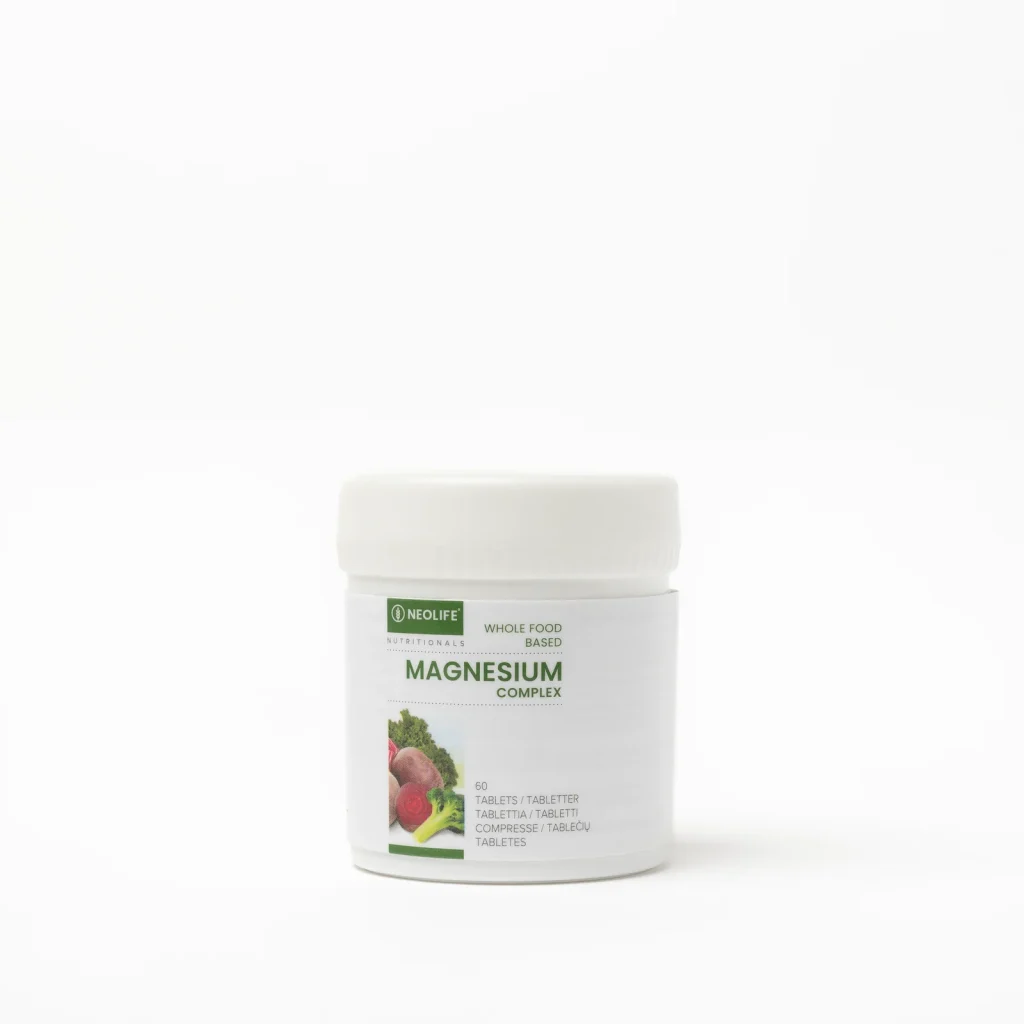
NeoLife Magnesium Complex takes the blended approach. Its Tri-Mag Blend provides 300mg of magnesium per two-tablet serving — the NHS daily figure for a man, slightly above it for a woman — drawn from three forms: magnesium bisglycinate (chelated with glycine), magnesium citrate and magnesium hydroxide. At 300mg (80% NRV), magnesium contributes to the reduction of tiredness and fatigue, to normal muscle function and to the maintenance of normal bones. Alongside that sits a PhytoMag blend of whole beet, kale, broccoli and radish — foods that are natural sources of magnesium in their own right.
It’s vegan, made without animal-sourced ingredients of any kind. A pot holds 60 tablets — a month at two a day — for £22.50, which works out at about 75p a day at two tablets.
See Magnesium Complex’s full details and order it here.
When to take magnesium
The honest answer: whenever you’ll actually remember it, consistently. Many people take magnesium in the evening simply because it slots into a wind-down routine, and taking it with food reduces the chance of an upset stomach. What matters more than the clock is the ceiling: the NHS notes that taking high doses — more than 400mg a day from supplements — for a short time can cause diarrhoea, so this is another mineral where doubling up doesn’t help.
If you take prescribed medication — magnesium can interfere with some antibiotics and other drugs — check with your GP or pharmacist before starting. This article is general information, not medical advice.
Products in this guide
Common questions
Which type of magnesium is best?
No single form wins on everything. Glycinate and citrate are well absorbed and gentle on the stomach; oxide contains the most magnesium per milligram but is less well absorbed. Some supplements blend several forms to balance absorption, gentleness and cost rather than betting on one.
How much magnesium do I need per day?
The NHS says 300mg a day for men aged 19 to 64 and 270mg a day for women. Most people should be able to get this from a varied diet including spinach, nuts and wholemeal bread.
When is the best time to take magnesium?
Any time you can keep consistent. Many people choose the evening as part of a wind-down routine, and taking it with food reduces the chance of stomach upset. Consistency matters more than the specific hour.
Can you take too much magnesium?
Yes. The NHS notes that taking more than 400mg a day from supplements for a short time can cause diarrhoea. Stick to the dose on the label rather than doubling up.
What are the signs of low magnesium?
Signs of low intake are non-specific; if you are concerned, speak to your GP, who can test for it.
Sources
- Vitamins and minerals: others (including beta-carotene, magnesium and zinc) NHS
- Great Britain nutrition and health claims (NHC) register Department of Health and Social Care, GOV.UK
- Dietary Reference Values (DRV Finder) European Food Safety Authority
Sources checked 16 October 2026. Health claims on this page use only wording authorised in Great Britain. How we write and check our guides.
Genuine NeoLife, delivered in the UK
Free UK delivery on orders over £150. Order online, no membership needed.
Food supplements should not be used as a substitute for a varied and balanced diet and a healthy lifestyle. This article is general information and not medical advice — if you have a health condition or take medication, speak to your GP or pharmacist before starting a new supplement.
Not sure magnesium is the gap in your diet? Pick the option that sounds most like you and we’ll point you at something sensible. You might also want our plain-English guide to zinc — the two minerals share the “more is not better” rule.
More guides
 Vitamins & mineralsWheat germ oil and vitamin E: what they are and how to chooseAn honest guide to wheat germ oil and natural vitamin E: what it gives you, the one authorised claim, natural vs synthetic vitamin E,…
 Vitamins & mineralsVitamin C benefits: what it does, and how to choose a supplementWhat vitamin C actually does — backed by authorised UK health claims — how much you really need, food sources, and how to choose…
 Vitamins & mineralsDo multivitamins actually work? An honest answer from a shop that sells themA multivitamin can't fix a poor diet — and we sell them. Who genuinely benefits, what the NHS says, and how to read a…
