
Omega-3 & CoQ10
EPA and DHA explained: how much omega-3 you actually need
Aug
Last reviewed Next review April 20275 sources
Quick answer
What are EPA and DHA?
EPA and DHA are the two long-chain omega-3 fatty acids found mainly in oily fish. They are the forms the body uses directly; the plant omega-3 ALA has to be converted, and that conversion is inefficient. The authorised UK heart claim applies from 250 mg of EPA and DHA a day, so read the EPA and DHA milligrams on a label, not the total fish oil.
Key facts
- EPA is eicosapentaenoic acid; DHA is docosahexaenoic acid.
- Heart claim: 250 mg of EPA and DHA a day. Brain and vision claims: 250 mg of DHA a day.
- The NHS advises at least 2 portions of fish a week, including 1 of oily fish.
- A "1,000 mg fish oil" capsule with 180 mg EPA and 120 mg DHA gives 300 mg that counts.
EPA and DHA are the two omega-3 fatty acids that matter most in the fish-oil conversation — and the two letters worth understanding before you buy any omega-3 supplement, because a bottle can shout “1000mg of fish oil!” while quietly containing very little of either. This guide explains what EPA and DHA actually are, what the UK guidance says about fish and omega-3, how much you need for the officially recognised effects, and how to read an omega-3 label properly.
In this guide
What are EPA and DHA?
EPA (eicosapentaenoic acid) and DHA (docosahexaenoic acid) are long-chain omega-3 fatty acids found mainly in oily fish and marine sources. They’re the forms your body puts directly to work. A third omega-3, ALA (alpha-linolenic acid), comes from plant sources like flaxseed and walnuts — but your body must convert ALA into EPA and DHA before using it that way, and the conversion is inefficient. That’s the practical reason fish sources and plant sources aren’t interchangeable, and why supplement labels list EPA and DHA separately.
These two carry officially authorised claims in Great Britain: EPA and DHA contribute to the normal function of the heart, and DHA contributes to the maintenance of normal brain function and normal vision. Each comes with a condition attached — the effect is obtained with a daily intake of 250mg of EPA and DHA (for the heart claim) or 250mg of DHA (for brain and vision). Keep that 250mg figure in mind; it’s the yardstick for reading any label.
What the NHS says about fish
The NHS guidance on fish and shellfish is the UK’s food-first position: aim for at least two portions of fish a week, at least one of which should be oily — salmon, mackerel, sardines, trout, herring. Oily fish is the guidance’s centre of gravity precisely because it’s where EPA and DHA live. If you reliably eat oily fish every week, you may not need a supplement at all. The realistic case for one is the same as ever: most people don’t consistently do the thing the guidance asks.
How much omega-3 per day?
There’s no official UK daily target for omega-3 in milligrams — the guidance is expressed in fish portions instead. But the authorised-claim conditions give you a defensible floor: 250mg of EPA and DHA a day is the intake at which the recognised heart-function effect applies. A weekly portion of oily fish averages out at roughly that order of magnitude per day, which is why the two framings broadly agree.
That figure is also your label-reading tool. Flip any omega-3 product over and find the EPA and DHA milligrams per serving — not the total fish-oil weight, which includes everything else in the oil. A “1000mg fish oil” capsule delivering 180mg EPA and 120mg DHA gives you 300mg of what counts. The front of the bottle tells you the oil; the back tells you the omega-3.
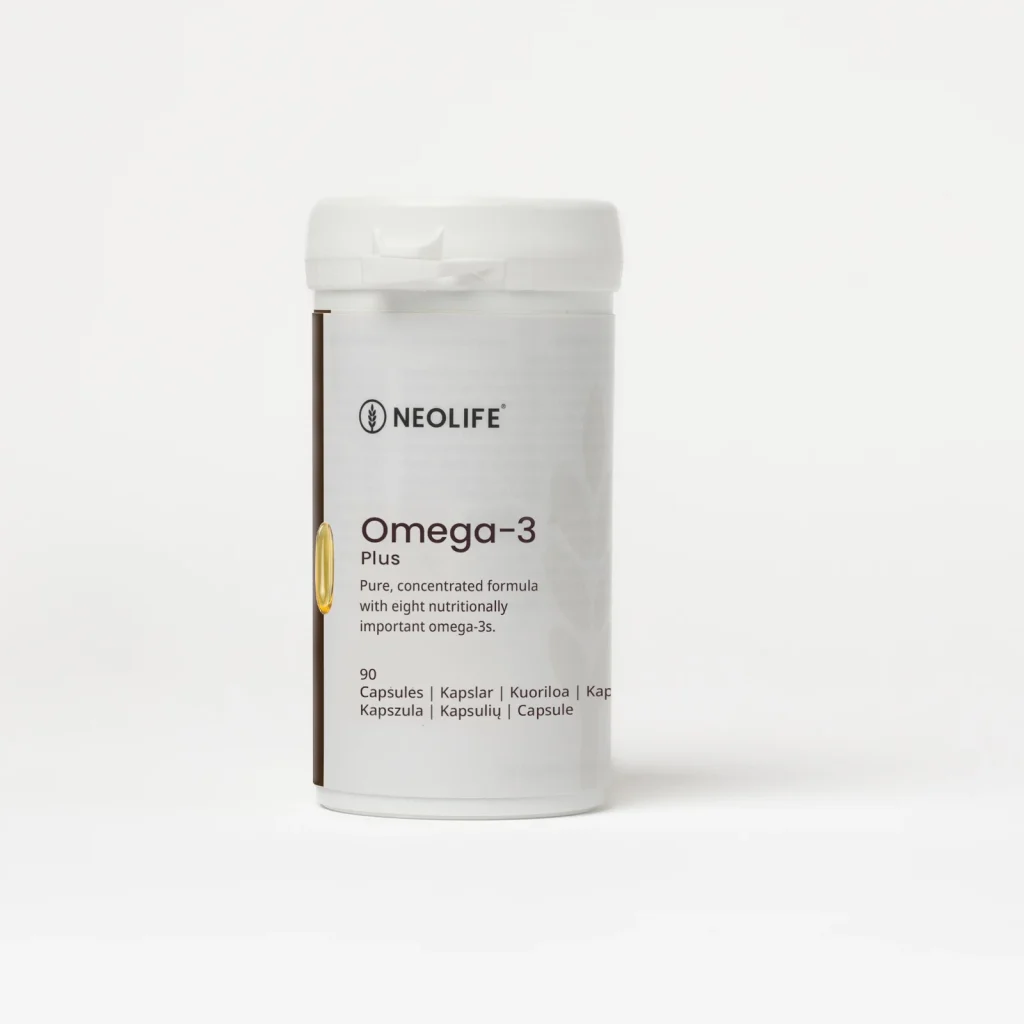
Omega-3 Plus: NeoLife’s fish oil
NeoLife Omega-3 Plus delivers 460mg of EPA and 480mg of DHA per three-capsule serving — comfortably clearing the 250mg conditions for the heart claim and the DHA brain-and-vision claims — alongside the other six omega-3 fatty acids naturally present in salmon oil.
The sourcing standard is the detail we’d point at first: the fish oils are screened for more than 200 potential contaminants, including mercury and lead, with an allowable detection limit of zero. A bottle holds 90 softgels — 30 days at the full three-capsule serving — for £38.00, which works out at £1.27 a day.
See Omega-3 Plus’s full details and order it here.
Fish oil vs. algae oil for vegans
EPA and DHA are made by marine algae; fish are rich in them because fish eat the algae. Algae-oil supplements go straight to that source, and they’re the only realistic way for vegans to get preformed EPA and DHA rather than relying on the inefficient ALA conversion. Our range doesn’t currently include an algae oil — if you’re vegan, that’s the label to look for elsewhere, and the same 250mg yardstick applies to it.
When to take omega-3
With a meal containing some fat — omega-3s are fats, and they absorb best in company. Taking fish oil on an empty stomach is also the classic cause of the “fishy burp”, so a mealtime habit solves two problems at once. If you take blood-thinning medication, speak to your GP or pharmacist before starting a fish-oil supplement — this article is general information, not medical advice.
Products in this guide
Common questions
What is the difference between EPA and DHA?
Both are long-chain omega-3 fatty acids from marine sources. EPA (eicosapentaenoic acid) and DHA (docosahexaenoic acid) together contribute to normal heart function, while DHA on its own also contributes to the maintenance of normal brain function and normal vision. Supplement labels list them separately because the amounts of each vary between products.
How much omega-3 do I need per day?
The UK has no official daily milligram target — the NHS guidance is at least two portions of fish a week, one of them oily. The officially recognised heart-function effect applies at a daily intake of 250mg of EPA and DHA, which is a practical yardstick when comparing supplement labels.
Is 1000mg of fish oil the same as 1000mg of omega-3?
No. The fish-oil figure is the weight of the whole oil; the EPA and DHA content within it is usually much lower. Check the milligrams of EPA and DHA per serving on the back label — that is the number that matters.
Can vegans get EPA and DHA?
Yes, from algae-oil supplements — algae are where fish get their omega-3 in the first place. Plant foods like flaxseed provide ALA, which the body converts to EPA and DHA only inefficiently, so algae oil is the realistic vegan route to preformed EPA and DHA.
When should I take fish oil?
With a meal that contains some fat, which helps absorption and avoids the fishy aftertaste that comes with taking it on an empty stomach. If you take blood-thinning medication, check with your GP or pharmacist first.
Sources
- Fish and shellfish NHS
- Facts about fat NHS
- Great Britain nutrition and health claims (NHC) register Department of Health and Social Care, GOV.UK
- Regulation (EU) No 432/2012 on permitted health claims, as it applies in Great Britain legislation.gov.uk
- Dietary Reference Values (DRV Finder) European Food Safety Authority
Sources checked 16 October 2026. Health claims on this page use only wording authorised in Great Britain. How we write and check our guides.
Genuine NeoLife, delivered in the UK
Free UK delivery on orders over £150. Order online, no membership needed.
Food supplements should not be used as a substitute for a varied and balanced diet and a healthy lifestyle. This article is general information and not medical advice — if you have a health condition or take medication, speak to your GP or pharmacist before starting a new supplement.
Not sure omega-3 is your actual gap? Pick the option that sounds most like you and we’ll point you at something sensible. For the other supplement the UK guidance singles out, see our guide to vitamin D and whether D3 is vegan.
More guides
 Omega-3 & CoQ10Garlic supplements: allicin and how to choose oneAn honest guide to garlic supplements: what allicin is and why delivery matters, why no GB health claims are authorised, the blood-thinning safety point,…
 Omega-3 & CoQ10What is CoQ10? An honest UK guide to coenzyme Q10An honest, claim-free guide to coenzyme Q10: what it is, why GB law authorises no health claims for it, ubiquinone vs ubiquinol, and how…
 Plant nutrientsLutein and Zeaxanthin: Food Sources, Supplements and What the Research ShowsLutein and zeaxanthin explained: the best food sources, why no UK health claims are authorised, what the AREDS2 eye research tested, and how to…
