
Vitamins & minerals
Is vitamin D3 vegan? A UK guide to vitamin D and going plant-based
Aug
Last reviewed Next review April 20274 sources
Quick answer
Is vitamin D3 vegan?
Not usually. Most vitamin D3 (cholecalciferol) is made from lanolin, from sheep’s wool, so it is not vegan. Vegan D3 made from lichen does exist, and vitamin D2 is vegan by nature. The NHS advises everyone in the UK aged 4 and over to consider 10 micrograms (400 IU) of vitamin D a day from October to March.
Key facts
- Standard D3: from lanolin (sheep’s wool).
- Vegan D3: from lichen. Vitamin D2: from fungi or yeast.
- NHS: consider 10 micrograms (400 IU) a day, October to March.
- A label that only says "vitamin D3" is usually lanolin; look for lichen as the stated source.
Yes — vitamin D3 can be vegan. But most of it on UK shelves isn’t. The standard version of D3 (cholecalciferol) is made from lanolin, extracted from sheep’s wool, which rules it out for anyone avoiding animal-derived ingredients. A genuinely vegan version exists too, made from lichen. This guide explains the difference between D2 and D3, how much the NHS actually says you need, what low vitamin D can mean, and what to check on a label if going vegan matters to you.
In this guide
Why the NHS advises most people in the UK to consider vitamin D in autumn and winter
The NHS recommends that everyone in the UK aged 4 and over consider a daily 10 microgram (400 IU) vitamin D supplement during autumn and winter — October to March. The reason is straightforward: your body makes vitamin D when UVB rays from sunlight hit your skin, and for roughly half the year, UK daylight isn’t strong enough for that to happen reliably, whatever the weather looks like outside.
Some groups are advised to take a supplement all year round rather than just in winter: people who get little or no sun exposure, anyone in a care home, people with darker skin (the British Heart Foundation notes this applies particularly to those of South Asian, African, Caribbean or Black African descent, whose skin needs more sun exposure to produce the same amount of vitamin D), and children aged 1 to 4.
Food supplies very little of it — oily fish, egg yolks and fortified foods are about the only sources, and the NHS is clear that most people can’t get enough from diet alone. That combination of a short window of useful sunlight and few dietary sources is why the NHS advises most people to consider a vitamin D supplement in autumn and winter, rather than only people with a diagnosed deficiency.
Is vitamin D3 vegan?
Not by default. Vitamin D3 (cholecalciferol) is the form your skin makes from sunlight, and it’s also the form most supplement manufacturers use. The problem for vegans is where it usually comes from: standard D3 is extracted from lanolin, the oil in sheep’s wool. It’s an animal by-product, not a slaughter by-product, but it’s an animal product all the same, and it rules D3 out for most vegans by default.
There is a genuinely vegan source of D3, though it’s less common: lichen. Lichen extract — usually from a species called Cladonia rangiferina, also known as reindeer lichen — can be processed into cholecalciferol without any animal input at all. Vitamin D2 (ergocalciferol) is the other vegan option, and it’s vegan by nature rather than by special sourcing: it’s made from irradiated fungal or yeast sterols, most often from mushrooms or yeast.
| Form | Usual source | Vegan? |
|---|---|---|
| Vitamin D3 (standard) | Lanolin (sheep’s wool) | No |
| Vitamin D3 (vegan) | Lichen (Cladonia rangiferina) | Yes |
| Vitamin D2 | Irradiated fungal or yeast sterols (often mushroom) | Yes |
Neither vegan option is labelled that way automatically — a product simply listing “vitamin D3” with no further detail is very likely lanolin-derived. If going vegan matters to you, the label needs to say so explicitly, or name the source.
What is vegan vitamin D3 made from?
Lichen — specifically Cladonia rangiferina, reindeer lichen. It’s a slow-growing organism that isn’t a plant: it’s a partnership between a fungus and an alga, and it’s currently the only widely available source of true vegan D3. It’s more expensive to process than lanolin, which is part of why lanolin-derived D3 remains the default across most of the market.
How much vitamin D should you actually take?
The NHS standard recommendation is 10 micrograms (400 IU) a day for most adults and children over 4. Some products are formulated at higher strengths — 25µg is common on UK shelves — aimed at people whose GP or blood test results suggest they need more, rather than as a default.
There’s an upper limit worth knowing: the NHS advises against taking more than 100 micrograms (4,000 IU) a day unless a doctor has specifically told you to, since very high doses over long periods can cause problems with how your body manages calcium. This is general guidance, not personal medical advice — if you have a health condition, take prescribed medication, or aren’t sure what dose is right for you, that’s a conversation for your GP or pharmacist rather than a supplement label.
Vegan D: NeoLife’s vitamin D supplement
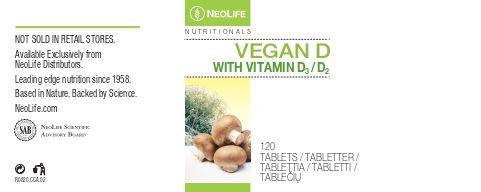
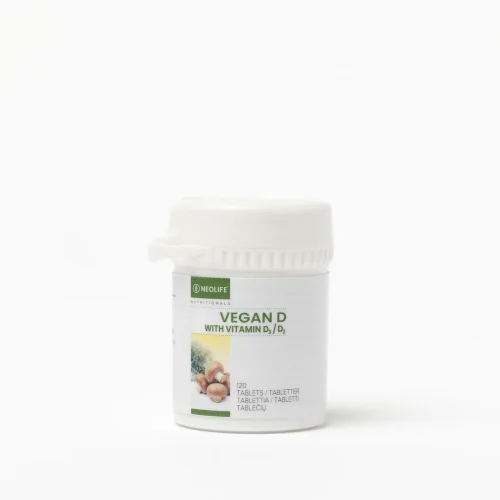
NeoLife Vegan D is the vitamin D tablet we sell, and its vitamin D comes from a blend of sources: mushroom extract (Agaricus bisporus) and lichen extract (Cladonia rangiferina) — the vegan D3 source above — alongside added vitamin D2 (ergocalciferol). Each tablet provides 10µg of vitamin D, which is 200% of the Nutrient Reference Value and matches the NHS’s standard daily recommendation exactly. The recommended intake is one tablet a day.
Because the amount per tablet clears the threshold for a significant source of the nutrient, vitamin D can carry these authorised claims: vitamin D contributes to the normal absorption and utilisation of calcium and phosphorus, to the maintenance of normal bones and teeth, to the maintenance of normal muscle function and to the normal function of the immune system. These are the standard, government-approved wording for vitamin D generally — they describe what the nutrient does, not a promise about how you personally will feel.
A bottle holds 120 tablets — four months at one a day — for £25.00, which works out at 21p a tablet.
See Vegan D’s full details and order it here.
When to speak to a pharmacist instead
Vitamin D can interact with certain medications, including some heart and blood pressure treatments and drugs affecting how your body handles calcium. If you take prescribed medication, are pregnant or breastfeeding, or have a diagnosed health condition, check with your GP or pharmacist before starting any new supplement. That applies whichever vitamin D product you’re looking at, ours included — this article is general information, not a substitute for advice tailored to you.
Products in this guide
Common questions
Is vitamin D3 always vegan?
No. Most vitamin D3 (cholecalciferol) is derived from lanolin, which comes from sheep’s wool, so it isn’t vegan. A vegan version of D3 exists, made from lichen. Vitamin D2 (ergocalciferol) is made from fungal or yeast sources and is generally vegan. Vegan supplements will state clearly which form they use.
Does the NHS recommend vitamin D supplements?
Yes. The NHS recommends that everyone in the UK aged 4 and over consider a daily 10 microgram (400 IU) vitamin D supplement during autumn and winter, when sunlight isn’t strong enough for the body to make its own. Some groups are advised to take it all year round.
What are the signs of vitamin D deficiency?
The NHS notes that a lack of vitamin D can lead to bone problems such as rickets in children and bone pain caused by osteomalacia in adults. Symptoms are often vague, so a low level should be confirmed by a blood test arranged by your GP rather than assumed.
What is vegan vitamin D3 made from?
Vegan vitamin D3 is made from lichen, a slow-growing partnership between a fungus and an alga. It’s the only widely available vegan source of D3 specifically — vitamin D2, made from irradiated fungal or yeast sterols, is the more common vegan alternative.
Can I take vitamin D with my other medication?
Vitamin D can interact with some medications, including certain heart and blood pressure drugs and treatments affecting calcium levels. If you take prescribed medication or have a diagnosed health condition, check with your GP or pharmacist before starting a supplement — this article is general information, not medical advice.
Sources
- Vitamin D NHS
- Vitamin D and Health report (2016) Scientific Advisory Committee on Nutrition, GOV.UK
- Vitamin D The Vegan Society
- Vitamin D: deficiency, supplements, sunlight and diet British Heart Foundation
Sources checked 16 October 2026. Health claims on this page use only wording authorised in Great Britain. How we write and check our guides.
Genuine NeoLife, delivered in the UK
Free UK delivery on orders over £150. Order online, no membership needed.
Food supplements should not be used as a substitute for a varied and balanced diet and a healthy lifestyle. This article is general information and not medical advice — if you have a health condition or take medication, speak to your GP or pharmacist before starting a new supplement.
Not sure vitamin D is what you’re actually looking for? Pick the option that sounds most like you and we’ll point you at something sensible.
More guides
 Vitamins & mineralsWheat germ oil and vitamin E: what they are and how to chooseAn honest guide to wheat germ oil and natural vitamin E: what it gives you, the one authorised claim, natural vs synthetic vitamin E,…
 Vitamins & mineralsVitamin C benefits: what it does, and how to choose a supplementWhat vitamin C actually does — backed by authorised UK health claims — how much you really need, food sources, and how to choose…
 Vitamins & mineralsDo multivitamins actually work? An honest answer from a shop that sells themA multivitamin can't fix a poor diet — and we sell them. Who genuinely benefits, what the NHS says, and how to read a…
