
Fibre & live cultures
Fibre supplements: do you need one and how to choose
Aug
Last reviewed Next review April 20274 sources
Quick answer
Do fibre supplements work?
UK guidance is 30 g of fibre a day for adults, but the government’s latest survey found adults aged 19 to 64 average 16.4 g, and 96% fall short. A typical fibre supplement gives only a gram or two per serving, so it tops you up rather than closing a gap of around 14 g. Fibre claims are authorised only for specific fibres at set daily amounts, such as 3 g of oat beta-glucan. Always take a fibre supplement with plenty of water.
Key facts
- Adults: 30 g of fibre a day (UK guidance).
- Adults aged 19 to 64 average 16.4 g a day; 96% miss the 30 g target (NDNS 2019 to 2023).
- Most fibre supplements give 1–2 g per serving.
- Wholegrains, beans, lentils, fruit, vegetables, nuts and seeds close the gap faster.
Fibre is having a moment — gut health, fullness, “eat 30 plants a week”. Fibre supplements ride that wave, often promising more than a tablet can honestly deliver. This guide is the straight version: how much fibre you actually need, what a supplement can and cannot do, the one safety rule that genuinely matters, and how to choose if you decide you want one.
In this guide
- How much fibre do you need?
- Soluble and insoluble — why a blend
- The honest part: what a fibre supplement can and cannot claim
- The one safety rule: take it with water
- Food first — and it really is better here
- What to look for when buying a fibre supplement
- The NeoLife option
- What we do not claim
- Related reading
How much fibre do you need?
UK guidance is 30 g of fibre a day for adults. Most people fall well short. The government’s latest National Diet and Nutrition Survey (2019 to 2023) found that adults aged 19 to 64 average 16.4 g a day, and that 96% of adults do not meet the 30 g recommendation. So there is a real, common gap. But notice the scale: the shortfall for a typical adult is around 14 g a day, while a typical fibre supplement provides only a gram or two per serving. That tells you immediately what a fibre supplement is: a top-up to a fibre-containing diet, not a substitute for one.
Soluble and insoluble — why a blend
Dietary fibre is not one thing. Insoluble fibre (wheat and rice bran, the tougher parts of grains and vegetables) adds bulk. Soluble fibre (apple pectin, oats, gums, citrus fibre) dissolves and forms a gel. A varied, whole-food diet naturally gives you both; a single-fibre supplement — a standalone psyllium or inulin — gives you one. A blend aims to provide both together. That is the honest reason to prefer a blend over an isolate: variety, closer to food. It is not a claim that the blend does anything specific.
The honest part: what a fibre supplement can and cannot claim
This is where fibre marketing gets loose. Some specific fibres do carry authorised GB health claims — for example, for oat and barley beta-glucans and for wheat-bran fibre. But every one of those claims comes with a required daily amount — for instance 3 g of beta-glucan a day. A general fibre blend that provides a couple of grams of mixed fibres does not deliver any single fibre at those levels, so it cannot carry those claims. If a fibre supplement page implies those claims without the dose to back them, it is overreaching. We would rather be plain: a small blended top-up is a top-up.
The one safety rule: take it with water
This matters more than any benefit. Fibre supplements — especially tablets and anything that swells — must be taken with plenty of water. Taken with too little liquid they can swell in the throat or gut, and there are genuine choking and obstruction warnings on fibre products for exactly this reason. Two practical rules: always take a fibre supplement with a full glass of water, and increase fibre gradually — jumping up quickly tends to cause bloating and wind. If you have a bowel condition or difficulty swallowing, check with your GP first.
Food first — and it really is better here
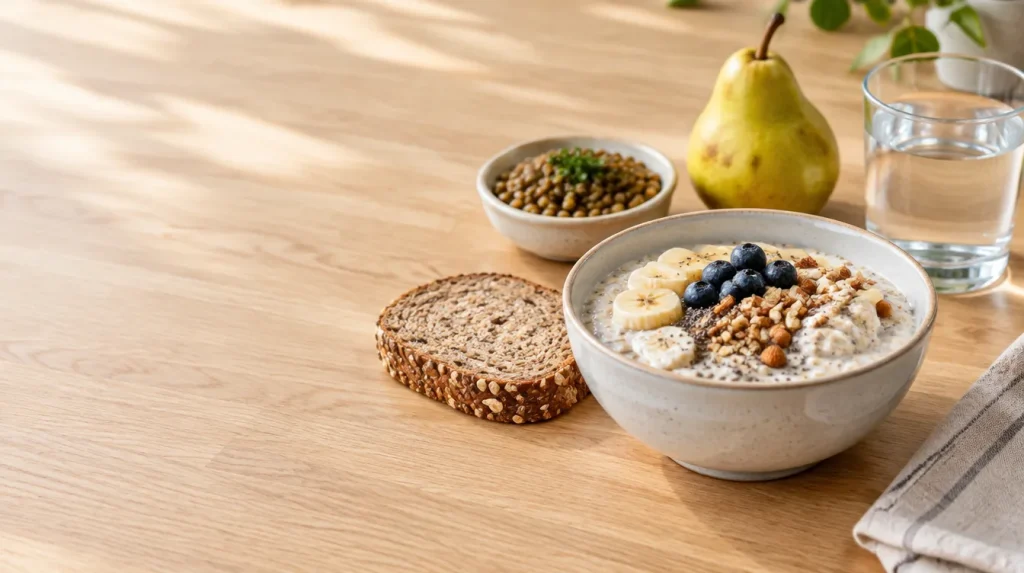
Of all the supplement categories, fibre is the one where “food first” is strongest, because whole foods bring fibre and everything it travels with. Wholegrains, beans and lentils, fruit with the skin on, vegetables, nuts and seeds will move you towards 30 g a day far more effectively than a tablet — a couple of extra portions of beans or wholegrains outweighs most supplements. A fibre supplement earns its place only as a convenience top-up when diet genuinely falls short.
What to look for when buying a fibre supplement
- Grams of fibre per serving, stated plainly — so you can see how small a top-up it really is.
- Blend vs single fibre, depending on whether you want variety or a specific fibre (e.g. beta-glucan or psyllium) at a meaningful dose.
- Added sugar or sweeteners, especially in fibre gummies and drinks.
- Allergens. Fibre blends often draw on grains and pulses, so soya, oats and barley (gluten) commonly appear — essential to check if you are coeliac or allergic.
- That it says “take with water” — and follow it.
The NeoLife option
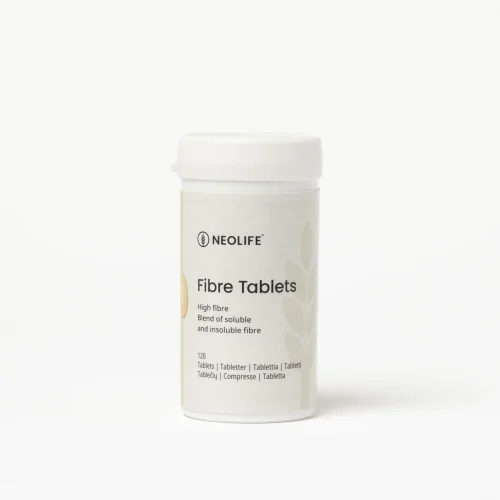
NeoLife Fibre Tablets combine seven fibre sources — rice bran, oat, gum arabic, soy, apple pectin, barley and orange — giving both soluble and insoluble fibre in one tablet, at roughly 2 g of fibre per four-tablet serving. It is 120 tablets, four a day with a glass of water (a 30-day supply, about 85p a day). Being honest about scale: at ~2 g a serving it is a top-up towards the 30 g daily target, not a way to hit it on its own. It contains soy, oat and barley (gluten), so it is not suitable if you are coeliac or allergic to those. £25.50.
What we do not claim
To be completely clear: this is a general fibre blend at a level below the amounts at which the specific authorised fibre claims may be used, so nothing here should be read as a promise of any health effect. It is a food supplement, not a medicine, and it is not intended to diagnose, treat, cure or prevent any disease. Always take with water and increase fibre gradually.
Products in this guide
Sources
- How to get more fibre into your diet NHS
- National Diet and Nutrition Survey 2019 to 2023: report Office for Health Improvement and Disparities, GOV.UK
- Carbohydrates and Health report (2015) Scientific Advisory Committee on Nutrition, GOV.UK
- Great Britain nutrition and health claims (NHC) register Department of Health and Social Care, GOV.UK
Sources checked 17 October 2026. Health claims on this page use only wording authorised in Great Britain. How we write and check our guides.
Genuine NeoLife, delivered in the UK
Free UK delivery on orders over £150. Order online, no membership needed.
More guides
 Fibre & live culturesAcidophilus and live-culture supplements: an honest UK guideAn honest guide to acidophilus and probiotic supplements: what live cultures are, why GB law authorises no probiotic claims, the milk allergen to watch,…
 Plant nutrientsLutein and Zeaxanthin: Food Sources, Supplements and What the Research ShowsLutein and zeaxanthin explained: the best food sources, why no UK health claims are authorised, what the AREDS2 eye research tested, and how to…
 Plant nutrientsPlant Sterols: Side Effects, How Much You Need and Who Should Avoid ThemPlant sterols explained: the authorised UK claims and the 0.8 to 3 g they need, the side effects and label warnings, who should avoid…
