
Plant nutrients
Green tea and herbal tea blends: an honest UK guide
Aug
Last reviewed Next review April 20273 sources
Quick answer
Do green tea and herbal tea blends have proven benefits?
No health claim is authorised in the UK for green tea, EGCG, ginseng, rhodiola or codonopsis, so no seller may say these blends boost energy, metabolism or immunity. The measurable ingredient is caffeine. Green tea extract products carry warnings: not for under-18s or during pregnancy or breastfeeding, and no more than 800 mg of EGCG a day from all sources.
Key facts
- Tea (Camellia sinensis) naturally contains caffeine and catechins such as EGCG.
- No authorised UK health claims for green tea, ginseng, rhodiola or codonopsis.
- Do not consume 800 mg or more of EGCG a day from all sources.
- Not for under-18s, or during pregnancy or breastfeeding.
Green tea — and increasingly blends that pair it with ginseng and rhodiola — are marketed hard, yet no health claim for them is authorised in the UK. This guide is the honest version: what these tea-and-herb blends are, what can and cannot be said about them, the safety warnings that legally come with green tea extracts, and how to choose.
In this guide
What green tea and herbal tea blends are
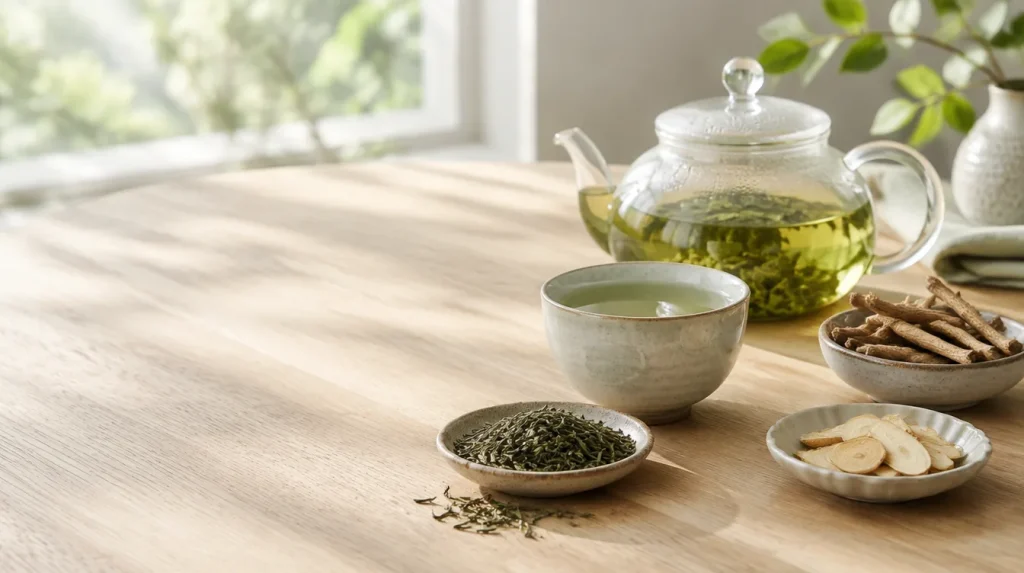
The base is usually tea — green, and sometimes black and white — from Camellia sinensis, which naturally contains caffeine and catechins such as EGCG (epigallocatechin-3-gallate). Herbal tea blends add extracts like Panax ginseng, rhodiola and codonopsis. They come as instant sticks, tea bags or capsules. The word “adaptogen” itself is a marketing term, not a regulatory one.
The honest part: what can and cannot be claimed
This is the bit the marketing skips. Green, black and white tea, EGCG, ginseng, rhodiola and codonopsis all carry no authorised health claims in Great Britain. The proposed claims were not authorised, so no one is permitted to make a health claim for a green tea or herbal tea blend, and a responsible seller will not imply one. What can honestly be said is what the product is: a naturally flavoured, usually low-calorie tea-and-herb drink that many people simply enjoy.
Important: the green tea safety warnings
These warnings appear on green tea extract products because of their EGCG content, and they are the most important thing on the page. A green tea product should tell you:
- Not for under-18s, and not for women who are pregnant or breastfeeding.
- Do not consume on an empty stomach.
- Do not consume alongside other green tea products on the same day.
- Do not consume 800 mg or more of EGCG per day from all sources.
- It contains caffeine — observe the stated per-serving amount and the daily serving limit.
If you take prescribed medication or are under medical care, check with your GP or pharmacist first. The EGCG limit matters because high intakes of concentrated green tea catechins have been linked to liver concerns — which is exactly why the 800 mg ceiling exists.
Caffeine is the real, measurable ingredient
Unlike the health claims, the caffeine is concrete. A strong green tea serving can carry as much caffeine as a cup of coffee, so check the per-serving figure and stick to the stated daily limit — especially later in the day, if you are sensitive to caffeine, or if you already drink coffee and tea.
What to look for when buying
- The EGCG and caffeine per serving, stated plainly — and the daily serving limit.
- The full green tea warnings — their presence is a sign of a compliant, honest product.
- Sweeteners. Flavoured tea blends are often sweetened (fructose, honey) — check if that matters to you.
- Allergens and suitability. Blends can contain soya, and any honey makes a product not vegan.
- Value per serving, not per pack.
The NeoLife option
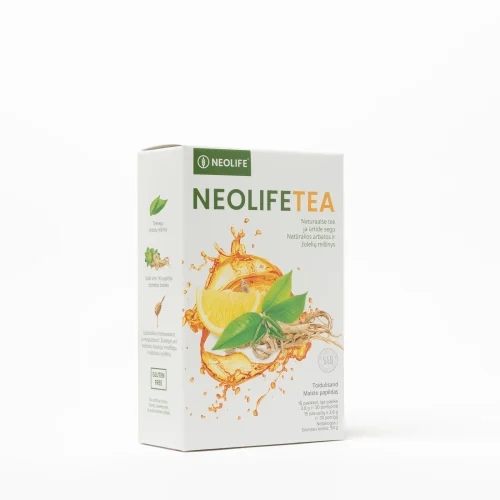
NeoLifeTea is an instant tea-and-herb drink in sticks (each of the 15 sticks makes two servings), blending green, black and white teas with standardised extracts of Panax ginseng, codonopsis and rhodiola, naturally flavoured with lemon and sweetened with fructose and honey — around 5 kcal a serving. Per serving it provides 85 mg of caffeine and 25 mg of EGCG, with a recommended 1–2 servings a day. Because it is a green-tea, caffeine-containing product, the warnings above apply — it is for adults 18+ only, not in pregnancy or breastfeeding, not on an empty stomach, and not alongside other green tea the same day. It is gluten-free but contains soya, and because it contains honey it is not vegan. A box of 15 sticks is 30 servings. £43.50.
What we do not claim
To be completely clear: the teas and herbs in this product have no authorised GB health claims, so nothing here should be read as a promise of any health effect. It is a food, not a medicine, and it is not intended to diagnose, treat, cure or prevent any disease. Observe the green tea and caffeine restrictions above, and if in doubt, speak to your GP or pharmacist.
Products in this guide
Sources
- Great Britain nutrition and health claims (NHC) register Department of Health and Social Care, GOV.UK
- Scientific opinion on the safety of green tea catechins (2018) EFSA Journal
- Green tea: usefulness and safety National Center for Complementary and Integrative Health (US NIH)
Sources checked 16 October 2026. Health claims on this page use only wording authorised in Great Britain. How we write and check our guides.
Genuine NeoLife, delivered in the UK
Free UK delivery on orders over £150. Order online, no membership needed.
More guides
 Plant nutrientsLutein and Zeaxanthin: Food Sources, Supplements and What the Research ShowsLutein and zeaxanthin explained: the best food sources, why no UK health claims are authorised, what the AREDS2 eye research tested, and how to…
 Plant nutrientsPlant Sterols: Side Effects, How Much You Need and Who Should Avoid ThemPlant sterols explained: the authorised UK claims and the 0.8 to 3 g they need, the side effects and label warnings, who should avoid…
 Plant nutrientsFlavonoids: what they are, the green tea caution and how to chooseAn honest guide to flavonoid supplements: what they are, why flavonoids carry no authorised claims, the green tea safety warnings, and how to choose.
