
Fibre & live cultures
Acidophilus and live-culture supplements: an honest UK guide
Aug
Last reviewed Next review April 20273 sources
Quick answer
What are the benefits of acidophilus?
Acidophilus (Lactobacillus acidophilus) is a live bacterium sold in live-culture supplements. No health claims for live cultures are authorised in Great Britain, so compliant UK pages make none. If you buy one, look for named strains, a count guaranteed to the end of shelf life rather than at manufacture, and check for milk: many cultures are grown on a dairy medium.
Key facts
- L. acidophilus is one of the best-known live-culture strains.
- No authorised UK health claims for live cultures.
- A bigger bacteria count is not automatically better.
- Many live-culture products contain milk from the growing medium.
Few supplement categories are marketed as heavily as live-culture supplements. Very little of that marketing is actually permitted under GB law. This guide is the honest version: what live-culture supplements like acidophilus really are, why you will not see benefit claims on a compliant UK page, and — if you decide to take one — the handful of things that genuinely separate a good product from an expensive one.
In this guide
What acidophilus and “probiotics” actually are
“Probiotic” is a marketing word for live bacteria (and sometimes yeasts) taken in the hope of adding to the population already living in your gut. Acidophilus — properly Lactobacillus acidophilus — is one of the best-known strains, but a good supplement usually combines several. The things that describe such a product factually are its strains (which specific bacteria), its count (how many live organisms, usually in billions), and its format (capsule, and how it is protected on the way down).
The honest part: what can and cannot be claimed
This is the bit most websites gloss over. In Great Britain, live-culture supplements carry no authorised health claims — and the word “probiotic” is itself treated as an unauthorised health claim, which is why a compliant shop will not use it as a benefit. No one is permitted to tell you that acidophilus, “friendly bacteria” or “gut flora” supplements improve your digestion, ease bloating, or support your immune system. Those claims were assessed and not approved.
So we will tell you exactly what a product is — the strains, the number of live organisms, how to take it and how to store it — and we will not tell you what it “does”, because we are not allowed to and the evidence bar was not met. If you have read confident benefit claims about probiotics elsewhere, those are running ahead of what GB law authorises.
What genuinely matters when choosing one
Because the benefit claims are off the table, the sensible way to compare live-culture supplements is on how they are built:
- Named strains, not just “acidophilus”. A product that lists its specific strains (e.g. Lactobacillus acidophilus, Bifidobacterium animalis) is being more transparent than one that just says “friendly bacteria”.
- The count — and when it is measured. Counts are given in billions of organisms. Crucially, check whether the figure is guaranteed at manufacture or to end of shelf life; live bacteria die off over time, so “5 billion at manufacture” and “5 billion until the best-before date” are not the same promise.
- Survival to the gut. Stomach acid kills bacteria, so the capsule matters. Some products use a capsule shell (often HPMC) designed to protect the cultures on the way through.
- Storage. Many live cultures keep better cold — check whether the product should be refrigerated after opening.
- Allergens. This is a big one for live cultures specifically (see below).
Bigger numbers are not automatically better
It is tempting to buy on the headline count — “50 billion!” beats “5 billion”, surely? Not necessarily. There is no authorised benefit to anchor a dose to, the strains present matter as much as the raw number, and a huge count measured only at manufacture may not mean much by the time you swallow it. Treat the count as one honest data point, not a league table.
The allergen most people miss
Live cultures are frequently grown on a dairy medium — skimmed milk powder — which means many acidophilus supplements contain milk even though the label is all about bacteria. If you avoid dairy, are vegan, or have a milk allergy, this is essential to check on any live-culture product, because it is easy to miss.
Food first
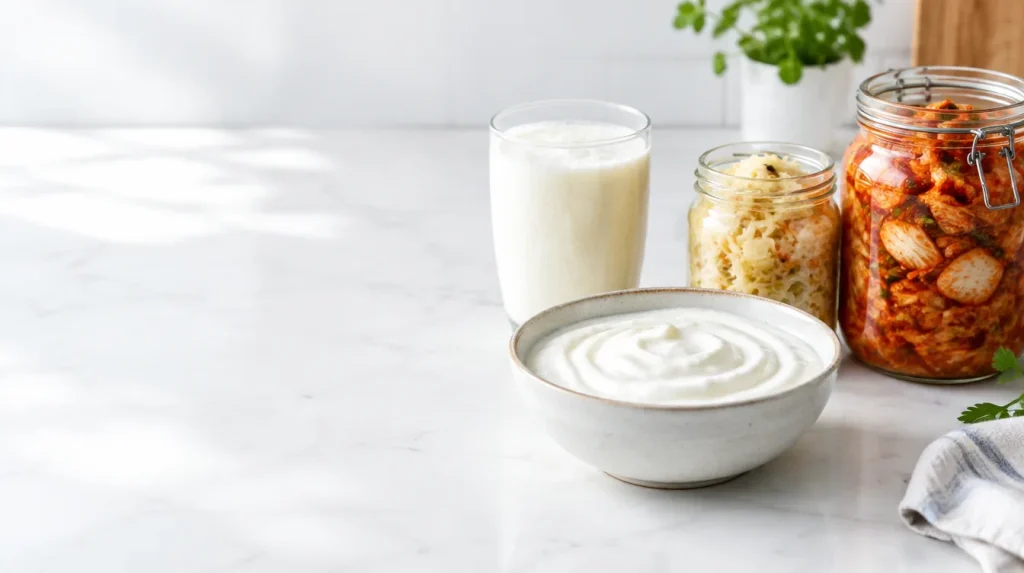
Live cultures also come in food: live yoghurt, kefir, and fermented foods such as sauerkraut, kimchi and miso. If your interest is simply in including more live cultures in your routine, fermented foods are a food-first way to do it — and they bring other things (and, in some cases, less sugar than a flavoured yoghurt) along with them.
The NeoLife option
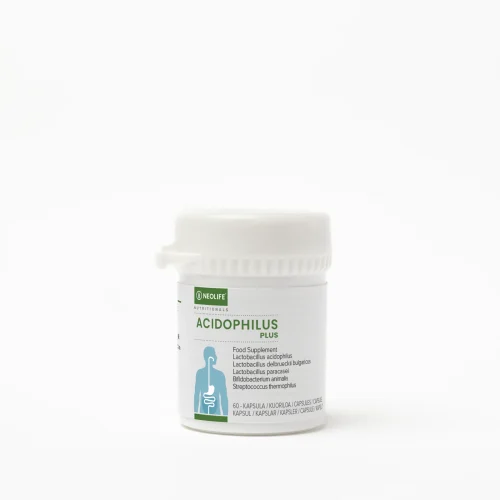
NeoLife Acidophilus Plus provides 5 billion live bacteria per capsule (measured at manufacture) from five named strains — Lactobacillus acidophilus, L. delbrueckii bulgaricus, L. paracasei, Bifidobacterium animalis and Streptococcus thermophilus. It is one capsule a day with a meal, in an HPMC (“Gel-Gard”) capsule intended to help the cultures pass through stomach acid, and 60 capsules make a two-month supply. Two things to know before you buy: it contains milk (the cultures are grown on skimmed milk powder), so it is not suitable for vegans or anyone with a dairy allergy; and it is best refrigerated after opening.
What we do not claim
To be completely clear: there are no authorised GB health claims for live cultures or acidophilus, and nothing on this page should be read as a promise of any health effect. It is a food supplement, not a medicine, and it is not intended to diagnose, treat, cure or prevent any disease. If you have a medical condition, are immunocompromised, or are pregnant, speak to your GP before taking live-culture supplements.
Products in this guide
Sources
- Probiotics NHS
- Great Britain nutrition and health claims (NHC) register Department of Health and Social Care, GOV.UK
- Probiotics: usefulness and safety National Center for Complementary and Integrative Health (US NIH)
Sources checked 16 October 2026. Health claims on this page use only wording authorised in Great Britain. How we write and check our guides.
Genuine NeoLife, delivered in the UK
Free UK delivery on orders over £150. Order online, no membership needed.
More guides
 Fibre & live culturesFibre supplements: do you need one and how to chooseAn honest guide to fibre supplements: how much fibre you need, why a small blend cannot carry the beta-glucan claims, the water safety rule,…
 Plant nutrientsLutein and Zeaxanthin: Food Sources, Supplements and What the Research ShowsLutein and zeaxanthin explained: the best food sources, why no UK health claims are authorised, what the AREDS2 eye research tested, and how to…
 Plant nutrientsPlant Sterols: Side Effects, How Much You Need and Who Should Avoid ThemPlant sterols explained: the authorised UK claims and the 0.8 to 3 g they need, the side effects and label warnings, who should avoid…
